New Choices For Ankle Arthritis
Most ankle arthritis follows an injury, especially a severe fracture. The joint surface is disrupted by the fracture, and eventually, the cartilage wears away and arthritis sets in.
New treatments are now available for ankle arthritis. Dr. DeGroot now offers minimally invasive ankle arthritis surgery for selected patients in his orthopedic surgery practice in Newton, Massachusetts. In addition, new ankle implants including the STAR and the InBone II ankle prosthesis with a computerized alignment system are now available.
Treatment depends on the severity of the arthritis. Since early stage arthritis is much easier to treat, Dr. DeGroot recommends that you get your ankle evaluated early, before severe damage sets in.
| New procedures are now available for ankle arthritis. |
 |
In the early phase of ankle arthritis, the cartilage damage is very limited. In these cases, arthroscopic and minimally invasive treatments are more effective. Loose pieces of cartilage can be removed from the joint. Small areas of damage or missing cartilage can be transplanted.
In addition to arthroscopy for early arthritis, supplementation of the joint fluid with hylagan, (Supartz, Synvisc, and others) has been proven to be effective in improving symptoms. This process involves three injections of supplemental joint fluid (hylagan) into the ankle. Dr. DeGroot uses ultrasound or fluoroscopy to verify the location of the injection, which prevents painful "hunting around" with the needle.
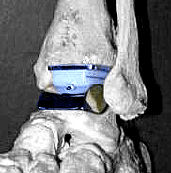 |
Ankle arthroplasty is an alternative to ankle fusion. It provides for superior range of motion. Click here for more on the STAR and the InBone II ankle. |
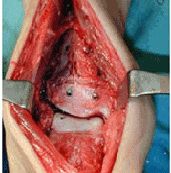
The later stages of ankle arthritis, the joint surfaces of the tibia, the fibula, and talus bone become severely damaged and most of the cartilage has been worn away. Ankle fusion was previously thought to be the only option here. Now, the STAR and InBone II ankle replacements are available that are the best choice for selected patients. Click here for more on the STAR and the InBone II ankle. In addition, distraction arthroplasty and allograft arthroplasty are options.
| Allograft replacement is an alternative to fusion and prosthetic replacement that may be appl;icable in selected cases. |
 |
|